Role-Based Skills Development for Security Teams
Get your security team ready for the work it actually does, and see where every skill stands. Turn any job description into a hands-on path in about a minute.
From a job description to a curated training path in a minute
New hires ramp sooner and skill gaps stop surprising you. Paste in any job description and SkillBit Labs builds a hands-on path for that role, then shows you who can do what.



A bigger library doesn't close a skill gap
Your SOC analyst isn't the SOC analyst in a course catalog. They work your stack, your playbooks, your clients. Generic content fills hours, and a completion report tells you who clicked through. Neither tells you who can do the job, so new hires take months to ramp.
of security leaders say a new hire takes six months or longer to deliver value
would rather their team train 20 minutes a week than in long annual blocks
value problem-solving ability over mastery of a specific tool
Source: The Shift to Continuous Cybersecurity Micro-Training, a survey of over 200 CISOs, CIOs, and security VPs.Read the report
A plan for every role, built in about a minute
Stop building onboarding plans by hand. Every new hire and role change gets a hands-on plan matched to the work, and you decide what's in it.
Use the role you're hiring for, or the one your team is growing into.
AI maps the role's skills to hands-on labs and modules, ordered from fundamentals to real scenarios.
Review it in Path Builder. Move, cut, or add anything, and lock the order so no one skips ahead.
Stages unlock in order, and you see who's on track and who's stuck.
Three ways to build

1.
Generate a path from any job description

2.
Build from a skills framework, like Framework Studio, MITRE ATT&CK, or OWASP Top 10

3.
Start from scratch with the Skills Library
One job description. Every stage of the talent lifecycle.
The same job description that opens a req can ramp the hire, grow the analyst, and show leadership the team is ready.

Onboarding
Ramp new hires on the real work
80% of security leaders say a new hire takes six months or longer to deliver value. A role-specific plan is waiting on day one, so new hires practice the job instead of watching videos about it.

Visibility
Find the gaps before an incident does
See what each person can do by role and skill, and whether their path is closing the gap.

Staffing
Staff and promote on proof
Lab results show who's ready for a new client, project, or promotion. Decide on demonstrated skill, not résumés or gut feel.

Retention
Make the path to promotion visible
People can see their skills grow and what earns the next role, which takes the mystery out of promotion. Analysts set a career goal, like moving from the SOC into incident response, and follow the path to get there.
What security leaders see
Your team practices the real work, not slides
Time goes to the skills your roles need, in the tools and frameworks your team already uses. No quizzes, no slideshows, no hours lost to content that doesn't fit the job.

650+ hands-on labs and 60+ modules, tagged by role, tool, and framework

Real progress between tickets, without pulling anyone off the floor

Team scoreboards, streaks, and badges keep people coming back

Nothing to download. Works on locked-down corporate devices
Skills data, not course completions
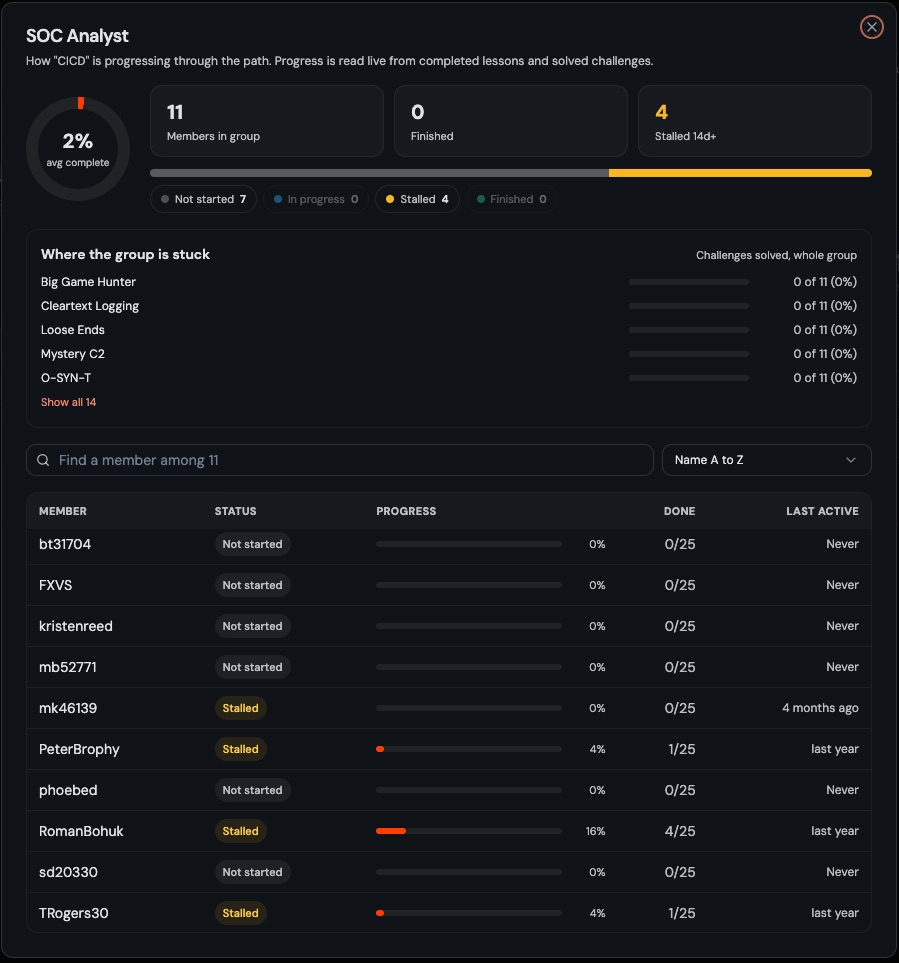
Know what your team can do, and take it upstairs. Every assigned path reports back what people can do: progress by person or team, where a group is stuck, and strengths you didn't know you had. When leadership asks whether the team is ready, you can show what each person can do, where the gaps are, and whether training is closing them.
- Who's on track and who's stuck, by person or team
- Skills and gaps by role, mapped to the frameworks you use
- Evidence for staffing, promotion, and budget conversations
Integrates with your LMS, LXP, and HR or Human Capital Management systems.





See what your team can do. Start with one role.
Paste in a job description and get a hands-on path built for it in about a minute.